Apple opens a consumer health AI study for up to 200,000 people, built with OpenEvidence
The virtual U.S. study gives iPhone users an app that answers health questions with OpenEvidence-generated responses and cited sources, and can draw on HealthKit data if participants opt in.
Apple is putting a health chatbot in front of as many as 200,000 iPhone owners, and framing it as research rather than a product.
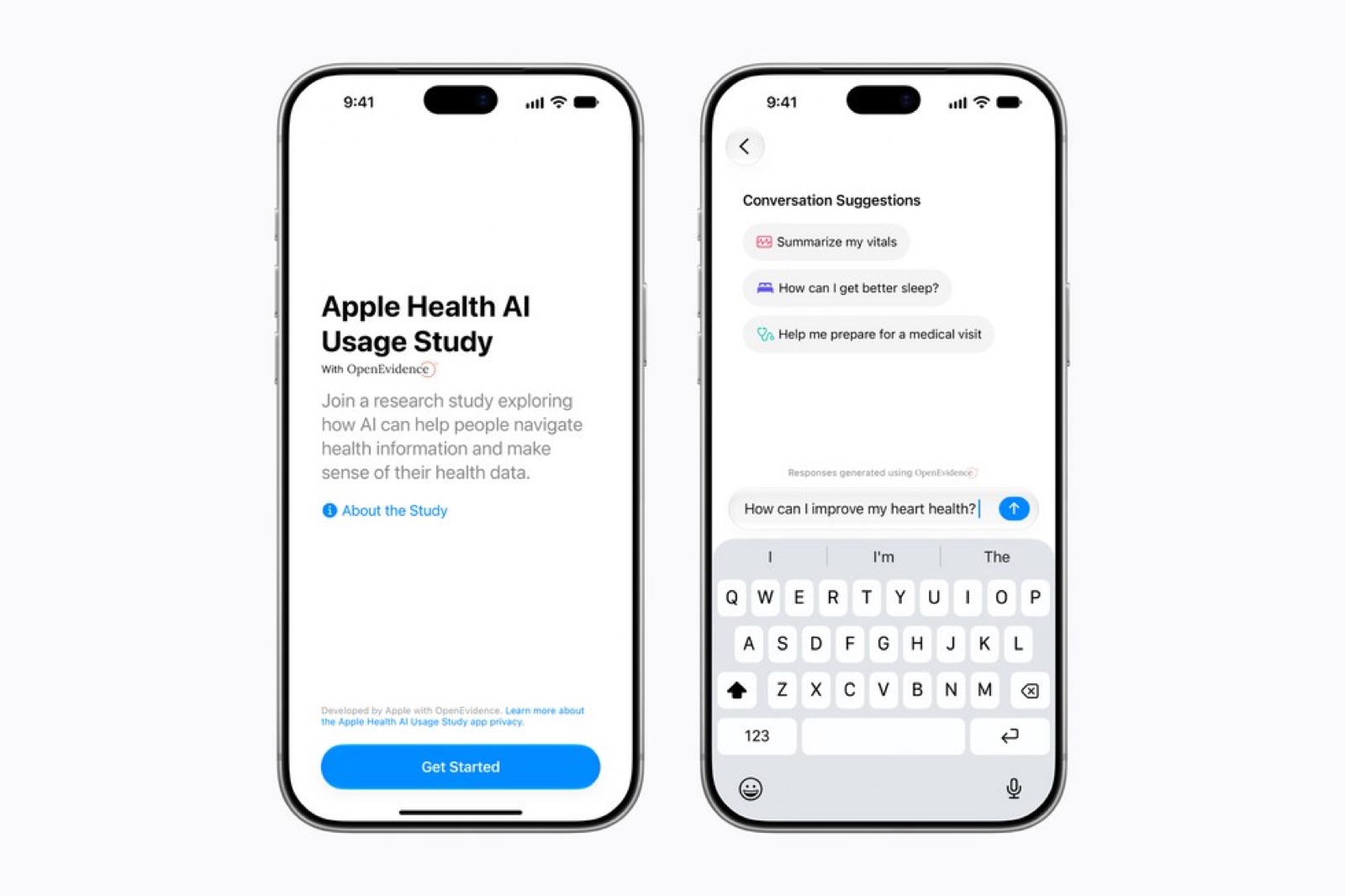
The company said Nov. 15 that it has launched the Apple Health AI Usage Study, a virtual U.S. research study with its own app, run in collaboration with OpenEvidence. Participants ask everyday health questions and get answers generated by OpenEvidence, with links to peer-reviewed clinical citations behind each response.
Why it matters: Apple said the study will look at what drives trust in conversational health AI, the quality of its answers, how well people understand them and what health actions they take afterward. It said the findings are meant to shape the design of health AI experiences for Apple and the industry. The study pairs Apple's consumer devices with OpenEvidence, which Apple described as widely used by health care professionals.
How the study works
OpenEvidence generates its answers from established medical sources, Apple said, naming The New England Journal of Medicine, the Journal of the American Medical Association and Nature. Apple designed the research experience around that technology.
Participants can choose to share HealthKit data such as resting heart rate, activity, sleep or lab results, so the study can test how personal data affects how relevant and understandable answers are. The study will also look at whether the tool can help people prepare for appointments with their own doctors, the company said.
"At Apple, we believe responsible innovation starts with scientific rigor and clinical grounding," said Sumbul Desai, Apple's vice president of Health and Fitness.
Apple acknowledged in the announcement that consumer tools built on large language models can sometimes give incomplete or unclear answers, which it cited as a reason to study the problem. The app includes guardrails meant to flag certain concerning questions and suggest that participants follow up with a provider or other resources. Apple said the study app is not meant to diagnose or treat any condition.
Robert Wachter, professor and chair of the Department of Medicine at UCSF, was quoted in the release on the split between the tools patients and doctors use. "Patients and clinicians are both turning to AI, but the tools they use are being built and tested in separate worlds," he said.
Who can join
The study is open to up to 200,000 people age 21 and older across the U.S. Participants need an iPhone that supports Apple Intelligence, which means an iPhone 15 Pro or later, running iOS 26 or later. Apple said study data will not be used to train AI models and that participants control whether to share HealthKit metrics or survey answers.
Where it fits
When Vera Health raised a $28.5 million Series A in October, it measured its downloads against OpenEvidence and Doximity. The Apple study takes OpenEvidence's answers to consumers rather than clinicians.
Apple did not disclose financial terms with OpenEvidence, how long the study will run or when it expects to publish results. It also did not say whether any findings will feed into a commercial Apple product.