With about 50 robots installed, MMI raises $125M to scale microsurgery sales
Existing investor BioStar Capital led the Series D, which MMI says brings its total funding to about $345 million. The company will spend it on U.S. and global sales of its Symani robot and on clinical studies.
- Amount
- $125M
- Type
- Series D
- Company
- MMI (Medical Microinstruments)
- Lead investor
- BioStar Capital
- Sector
- Medtech
- Announced
- Oct. 8, 2026
Medical Microinstruments Inc. has about 50 of its Symani surgical robots installed in hospitals around the world. On Oct. 8, the company known as MMI said it had raised $125 million to sell a lot more of them.
Existing investor BioStar Capital led the Series D round. New investors S3 Ventures and Angelini Ventures joined, along with a strategic corporate investor MMI did not name, and existing backers also put in money. The Jacksonville, Fla., company said on its investor page that the round lifts its total funding to about $345 million. It did not disclose a valuation.
Why it matters: With about 50 systems in the field and 3,500 procedures performed on them, MMI says its focus is now turning that adoption into scale, and this round is meant to pay for it. The company plans to spend on sales, new instrument development and studies aimed at new uses, and it has pointed to a new U.S. billing code for one of its core procedures.
"Now, our focus is translating that adoption into scale," Mark Toland, MMI's chief executive, said in the announcement.
Where the money goes
MMI said the capital will pay for growing sales in the U.S. and other major markets, plus clinical studies and outcomes research. Toland said it will also pay for development work in areas such as digital surgery and energy instruments. Louie Cannon, founder and senior managing director of BioStar, said the firm was excited to lead what he called an oversubscribed round.
MMI has also pointed to a change in U.S. reimbursement. In December 2025, MMI said the American Medical Association had issued a new Category III CPT code, 1019T, for lymphovenous bypass, with or without robotic assistance, effective Jan. 1, 2026. CPT codes are the procedure codes that hospitals and doctors use to bill health plans. MMI said the Centers for Medicare & Medicaid Services also finalized an outpatient payment rate for the procedure in its 2026 hospital outpatient payment rule. Before that, the company said, hospitals had to bill the surgery under unlisted codes.
The procedure joins small lymphatic vessels to adjacent veins so that fluid can drain, and MMI says Symani lets surgeons perform it.
The company and its backers
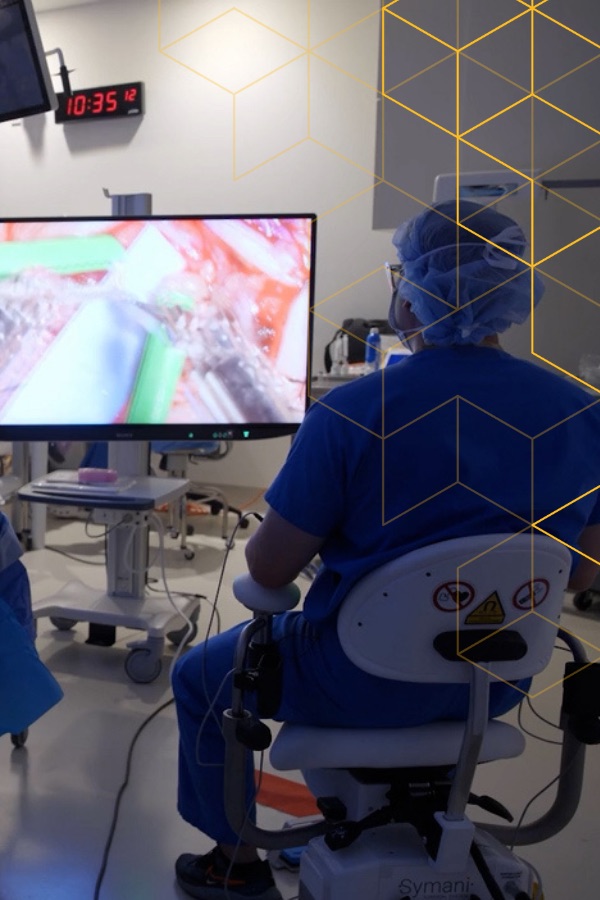
MMI was founded near Pisa, Italy, in 2015. It describes Symani as a robotic platform for open, soft-tissue surgery at the microsurgical level, pairing very small wristed instruments with tremor reduction and motion scaling. The company says the system is used for microvascular and lymphatic repair, and in Europe and the Asia-Pacific region also for peripheral nerve repair. MMI said Symani is authorized for U.S. use by the Food and Drug Administration and carries a CE mark in Europe.
The rounds have grown each time. According to the investor page, MMI raised a $24 million Series A led by Andera Partners; about $75 million in a 2022 Series B led by Deerfield Management and RA Capital, plus a $12 million extension; and a $110 million Series C in 2024 led by Fidelity Management & Research Company.
What to watch
The longest-range bet is REMIND, an early feasibility study of Symani in patients with Alzheimer's disease. In July, MMI said the FDA had approved a supplement to the study's investigational device exemption, allowing enrollment to grow from an initial group of no more than five patients to the full 15. The company said Symani remains investigational for that use and that REMIND data could inform a possible larger pivotal trial.
Nearer term, the measures to watch are how fast the installed base grows from about 50 systems, and whether MMI names its strategic investor.